Ring Around the Rosie

The Bachelor is back.

To be honest, did he ever really go away?

It certainly doesn’t feel like it, now that everything at the Bachelor Mansion seems to be back to business as usual. And by ‘usual’ I mean an interchangeable white male with a vague background which may or may not involve sports and absolutely no discernible personality traits. His story arc involves only one piece of information and it will be all that matters throughout the entire season.

Chris Soules was a farmer. Nick Viall was a regular. Peter Weber was a pilot. Colton Underwood was a virgin.

Clayton (Googles last name) Echard is…..

By god. He doesn’t even have ONE thing. Or rather, one thing we’re allowed to say out loud. In truth, Clayton’s Thing is being a whiteboard where the average American can project their “traditional values” and go back to feeling at peace with themselves.

It’s also no coincidence a new host has been chosen who’s nearly identical to both Clayton and Chris Harrison. The ways in which Jesse Palmer mimics Chris Harrison’s tone, cadences, stance and gestures is unsettling. It feels patronizing. “Oh, you all thought we were entering a new era? Joke’s on you, suckers! We just went full circle like a Neil Lane ring.”

Also, if Clayton and Jesse wanted to swap places for an episode and play out a fun Prince and Pauper switcheroo, they could absolutely pull it off. The women wouldn’t have a clue.

I confess, I’d watch the hell out of it.

Why the Hell Am I Watching Now?

Why do we do anything we know is bad for us? It feels good.

Watching The Bachelor (and The Bachelorette and Bachelor in Paradise) is consistently a refuge that provides my brain space to do nothing. It has been complete and total escapism.

It took me far too long to realize what a privilege that is. The very lack of variety on the show lulled me into a comfortable complacency and because I intentionally sought it out for it’s formulaic drama, I failed to see many of the most toxic elements of American culture embedded into its core. I just wanted to feel better about myself.

Am I still trying to use this franchise, albeit in a different light, to feel better about myself?

Yes. Yes. It’s shameful. It’s the truth.

When Clayton was rejected not once but TWICE before the first Rose Ceremony even happened, I felt vindicated beyond all reason. He was a terrible choice! Here was proof! There would be no discovery half way through, a’la Juan Pablo, that ABC had made a horrible error. This was going to be a train wreck not just before the ‘journey’ began, but during the boarding process.

As I rolled my eyes this way and that, it soon became clear that I could complain about Clayton all the live-long day, but in reality I was getting exactly what I wanted; an emotional dumpster fire that made me think perhaps my own engulfed trash bin of feelings didn’t actually smell like garbage.

Damnit.

Untangling the knot of moral quandaries around The Bachelor franchise is a series of posts unto itself, as well as a few solid therapy sessions. For now, in honor of two women saying “no” to Clayton’s “will you accept this rose?”, I’d like to say YES to the following Roses-

(NOTE: The following selections are based on fictional/cultural content (due to the theme of this site) and intentionally do not include real people of historical note. One real location is included as it is a theatre, as well as a real event also for theatrical means. End disclaimer.)

I Accept These Roses

Rose DeWitt Bukater Dawson
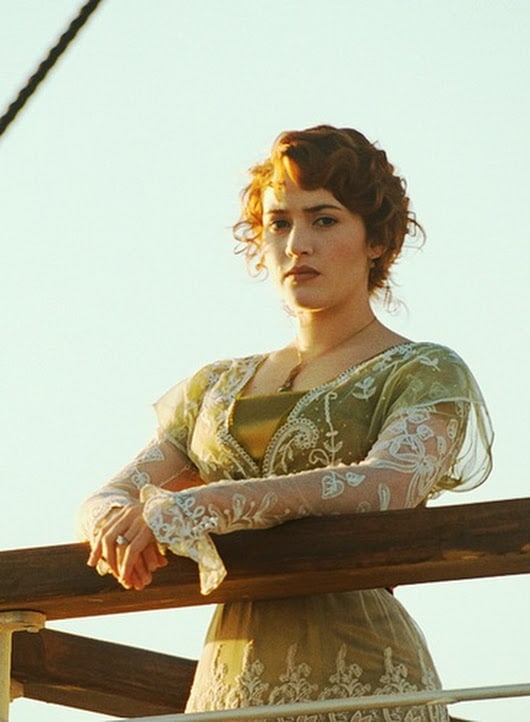
Kate Winslet as Rose DeWitt Bukater in Titanic (1997)

Rose outshines diamonds. Rose lives the life she wants in the wake of trauma and abuse. Rose is flawed. Rose is fearless. When Rose flies, we fly.

The Rose Theatre
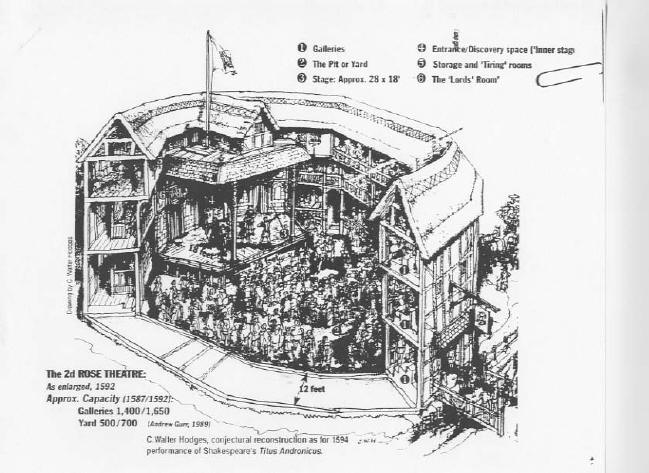
Drawing of the second Rose Theatre 1592

An additional shoutout to the rose Juliet refers to when she speaks oh so eloquently about names and sweet smells and all the whatnots of romance at age 14.

Rose Tico
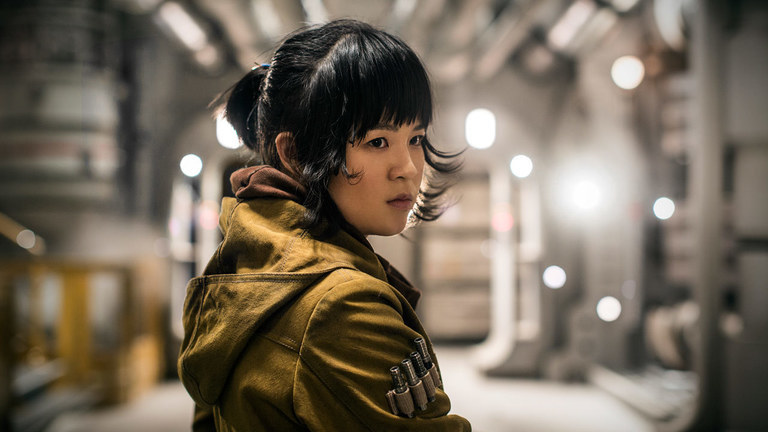
Kelly Marie Train as Rose Tico in Star Wars Episode VIII – The Last Jedi (2017)

Confession. (Deep breath). I’m not a Star Wars fan. I’ve seen all the films and they’ve been fun, but I’ve never connected with them as so many do. That being said, I loved the addition of Rose Tico. It was a shame we didn’t get more of her in The Rise of Skywalker. She was bright and fierce and driven by both passion and duty. Her voice and spirit made so much sense within the Star Wars universe. Get it together, Jedis!

The Rose Bowl
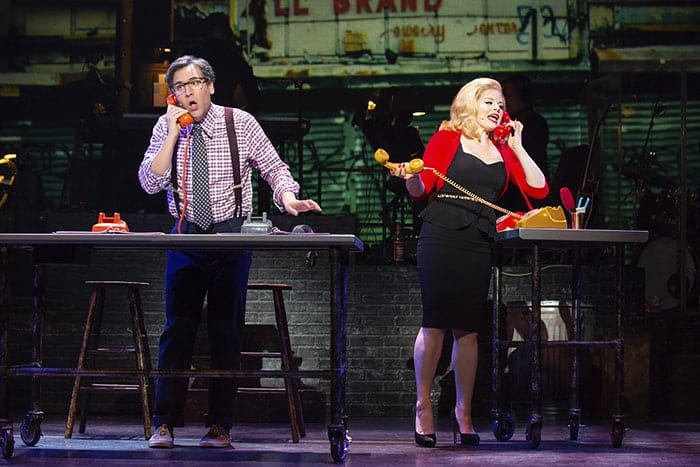
Josh Radnor and Megan Hilty in the Kennedy Center’s Broadway Center Stage 2018 production

Very specifically Audrey singing the line “the Rose Bowl, Seymour, the Rose Bowl” in Little Shop of Horrors.

Moira Rose

Catherine O’Hara, Schitt’s Creek (2020) Season 6. Credit: Comedy Central / The Hollywood Archive

“It’s probably nothing but I think I’ve killed a man.”

Moira Rose

Roseanne Roseannadanna

Gilda Radner on SNL as Roseanne Roseannadanna

It’s always somethin’! Also, no list of happiness is complete without Gilda Radner.

Detective Rosa Diaz

Stephanie Beatriz as Detective Rosa Diaz in Brooklyn Nine-Nine

“You can’t let other people’s opinions get in the way of what you want, especially because other people suck.”

Detective Rosa Diaz

The Enchanted Rose
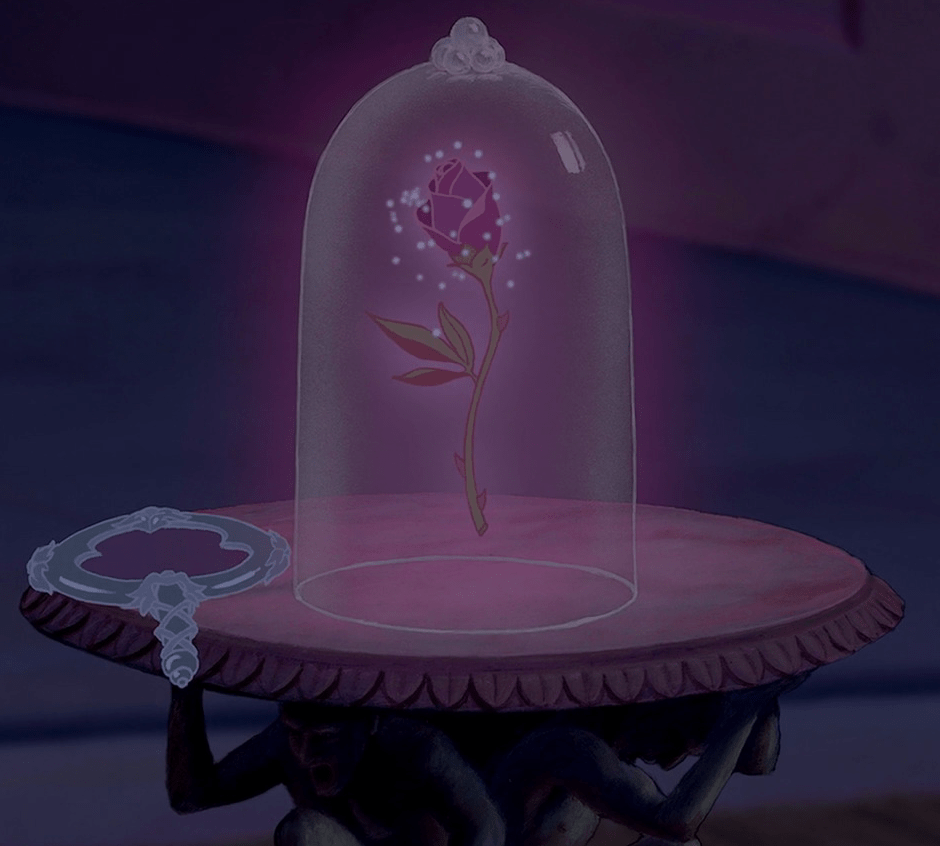
Disney’s Beauty and the Beast

This rose is so vicious. I love it so much. You just know that each time a petal drops it makes a judgey little “hmph” sound.

Rose Nylund

Betty White as Rose Nylund in The Golden Girls

Surely you knew in your heart it would all lead to this. Yeah sure, this Clayton dude is getting a ton of rose attention but we all know the real Rose we’re committed to loving for a lifetime.

Betty White lived an extraordinary life. It’s a testament to her character and talent that she will forever be seen as love and joy personified. To have a divided world universally agree on your excellence is no small feat.

As a culture, we err on the side of cynicism, we struggle to do what’s right, we’re cranky and miserable. Remember way back to the beginning of this blog post?

Complain, complain, complain.

Maybe 2022 is the year of second chances, the year of the benefit of the doubt. Or maybe it’s a year of patience and presence.

Regardless, for Betty, let’s laugh a lot more, enjoy what we love, and then share it as often as we can.

Cheers to you, Rose.

To Hades and Back Again…and Again…and Again

or Why I Looked Behind Me

It’s been a while, folks. But my excuse is solid. I’ve been dying.

Over and over and over again.

“WHAT?!”

Worry not. I’m very grateful for my good health here in the real world and owe an immense thanks to the scientists who created an incredible COVID shield that’s injected directly into my muscle. I didn’t pay a dime for it. It’s amazing.

“You’re not really dying?”

No.

“You shouldn’t joke about that.”

…that’s fair.

But this is true: I’ve been spending a lot of time in the Underworld.

Video Games and Me: a Non-History

I’m not a video game person.

I didn’t grow up in a big gaming household, though I did nerd out with the old school PC Carmen Sandiego games, as well as a Phantom of the Opera game that I LOVED. (It’s legit). We eventually acquired a console, a SEGA Saturn, which my husband insisted was impossible because NO ONE bought that console. “Everyone else had a Nintendo 64”.

We did not. SEGA Saturn. Real.

Eventually my youngest brother was gifted the Nintendo Game Boy and that told us everything we needed to know about our family rankings.

Regardless, I never took to video games. My instincts were terrible and my strategy of mashing buttons while flailing my arms and screaming got me nowhere.

Don’t even get me started on moving the camera around. I’ve decided Link is happier when he’s only looking at the sky and has no idea what’s coming.

Then I met and fell in love with my husband and entered the worlds of Red Dead Redemption, Shadows of Mordor, Death Stranding, and the most brutal of all, Mario Kart.

It used to be so simple, happy days of him slaying enemies while I sat next to him, content with my book. The thing about video game blood though, is that it splatters. Gradually, I became more and more invested in the characters, trials, and outcomes of every game he played.

I did not know I was at the top of the slippery slope.

So it begins

Way Down Under the Ground

Twitter was screeching, as it always does, and the topic was a new offering from Supergiant Games; Hades.

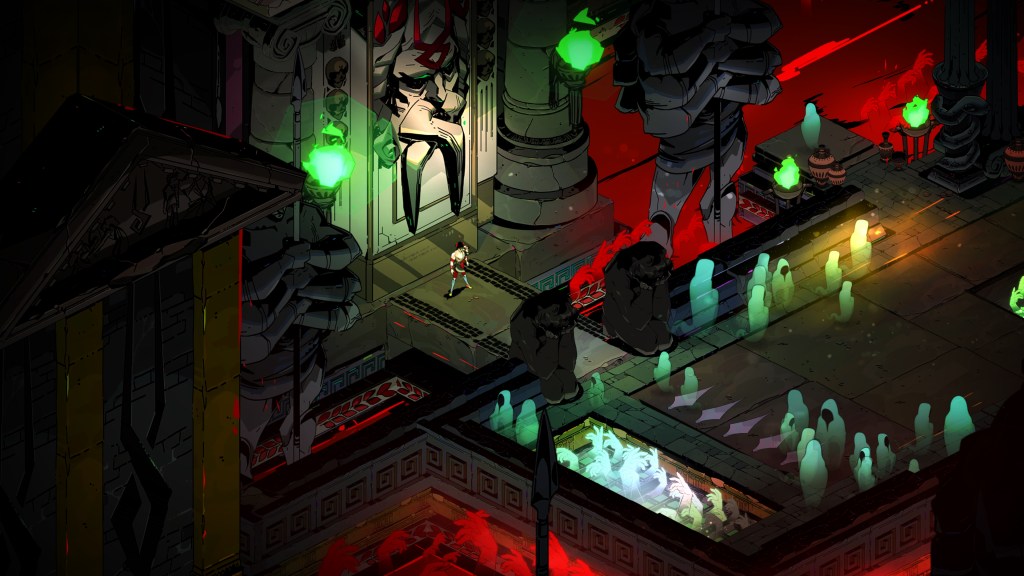
As a devoted fan of the musical Hadestown, I was intrigued. This could be a game I’d enjoy watching my husband play. But the more I learned about Zagreus, Son of Hades, and his battle to escape the Underworld, the more I realized this was a game I wanted to play.

I told my husband. He was so excited I was asking to play a video game he bought it immediately. No questions asked.

At this point, I hope it’s obvious (to those who have not played Hades) that it’s a spectacular game. So it should come as no surprise that the true gamers of the household could not resist the call of the River Styx and were soon consumed by the Underworld’s maddening delights.

One by one, they advanced through the Underworld’s regions, crushing skulls, slaying witches, and gathering blessings from the Gods. I watched.

This was for the best. I learned quickly that trying to understand new mental and physical concepts with a cacophony of back seat gamers all trying to tell you what to do while they actively recoil every time you do something asinine is…chaos.

So, my husband and two of our boys victoriously rose to the Hades challenge, while the rest of our children made significant progress, and I clapped for everyone.

And then, over a year later, I found myself in a state of mental despair, by which I mean an average Tuesday.

My usual comforts were not offering the distractions I relied on them for. I couldn’t slow my thoughts or get enough air. I felt agitated, frantic, desperate for both concrete action and stillness. Worse, I was angry with myself. I didn’t have time for this. I needed a pause button.

I picked up the Nintendo Switch.

Hades: Reluctant Santa of the Underworld

Blood and Darkness

I died so hard.

I’d get my ass kicked and die. I’d turn into stone and die. I’d step in lava and die. Instead of running away from fireballs, I’d run into them…and die.

I loved it so much.

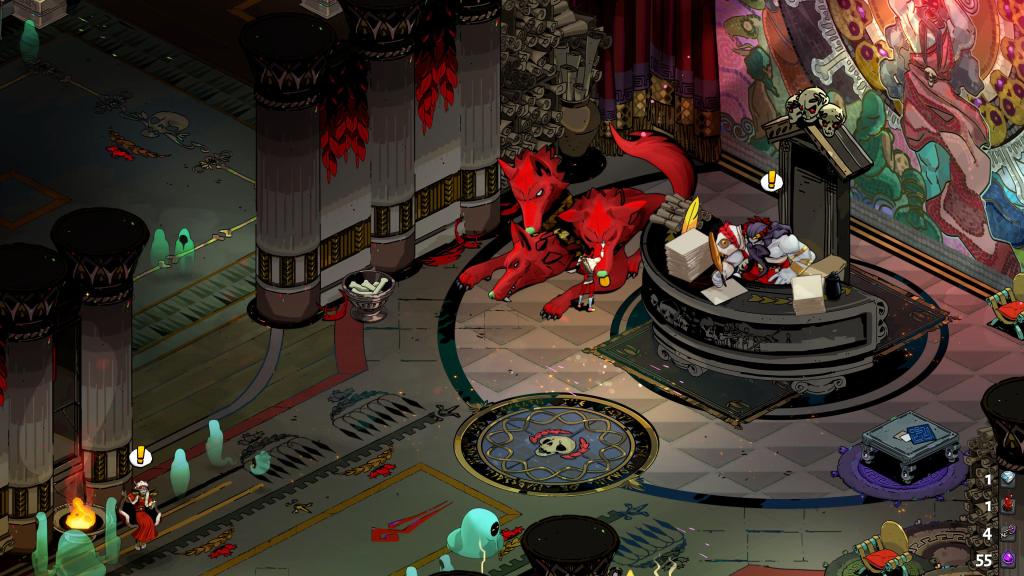
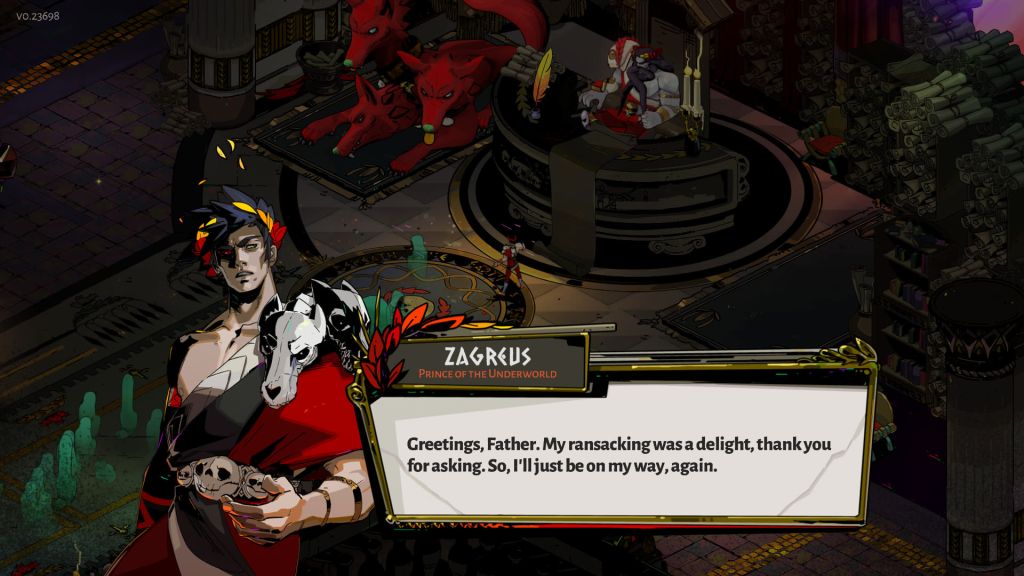
Every last breath sent me back to the beginning, facing new taunts from Hypnos, world-weary advice from Achilles, and romantic advances from anyone with eyes.

Yes, I spent a great deal of time partaking in a variety of violent acts. But Hades offers so much more:

  • Complicated Family Dynamics
  • Boy/Girl Love
  • Boy/Boy Love
  • Boy/Gorgon Love
  • A Sassy Narrator
  • Interior Decorating
  • Best Dog
  • Emotional Support Boulder
  • Bear Claws
  • Outstanding Filing Cabinets
  • One Committed Fan
  • Fishing

“What’s that?” you say? “You can go on a continual rampage of destruction and also find time for whimsy and love?” You bet your gorgon non-ass you can.

Look. At. That. Good. Boy.

It’s the craftsmanship that ultimately makes this mountain of delight work. Hades is a genuine work of art. Each detail, no matter how small, makes an impact on the Underworld. The dead whisper their cause of death as they wander aimlessly through one epic landscape after another. Every room is its own beautiful sentence within the chapter of a level. The style is both modern and timeless, suggesting the comfort of the Gods in any era, so long as power is theirs to wield.

And then the music. Ah, the music! Darren Korb’s gorgeous and exciting score (made all the more stunning by his vocals as Orpheus, alongside Ashley Barrett providing the singing voice for Eurydice) is the pulse of the game. It’s also apropos for daily life here above ground. I often turn to Good Riddance, or Lament of Orpheus when I just need to have FEELINGS, while The King and the Bull aptly prepares me for meetings. In the Blood is my go-to for trying to get the kids out the door for school on time.

It’s the characters in the Underworld (and Olympus) that bring the game to life, each of them written and performed to be distinct and memorable, while clearly remaining integral to the ensemble as a whole. There isn’t a weak link in the bunch. Even Charon sighs with intention.

All the interactions with these characters, be it Zeus, Sisyphus, or Tisiphone is so much fun that they nearly make death in the game to be desired. Sure I had to start all over again but I didn’t care. There was Dusa having a panic attack or Ares asking me for Nyx’s number. I couldn’t get enough of the story and so I happily accepted defeat again and again.

I did worry at one point that my actual gameplay was so poor that the game would run out of dialogue for me. And yes, some of Hypnos’ taunts felt personal. But I didn’t give up and I’m very proud to say that I did eventually beat the game.

So, if I’ve already won, why am I still playing it?

Facts

There is No Escape

Has Hades turned me into an official video game player?

Yeah, it has.

Sure, button combos still don’t make sense to me and mostly I really like to talk to characters and collect random items. But at the end of the day, this is a new art form for me that’s finally beginning to click.

I’ve since enjoyed played Undertale, Plants vs. Zombies, and Stardew Valley while tacking cracks at Hollow Knight and Celeste. As you can see, there’s no rhyme or reason to the level of difficulty I’ll choose to jump into.

I’ve also made a vow to a very important young man to play Slime Rancher. It shall be so.

But I digress. (It’s my thing).

Hades provided something else, though. It was profoundly good for my mental health.

“What?! That can’t be true. Video games turn us all into murderers!”

Well, in this case, yes. That’s true.

While I played Hades, I killed a lot of negative self-talk. I embraced my enemies, Failure and Frustration. It turns out we work really well together. I rediscovered a determination I’d thought too pitiful for the real world.

For reasons I still struggle to articulate (how many words later?) the victories of Hades made me feel stronger as the COVID Hydra refused to give up. It gave me a sense of control I could carry into the unknowns of reality. I was happy. Even better, it was a happiness I could actively share with my family as we all found joy in the adventure.

It also reminded me that blessings show up in a lot of different shapes and sizes, and while they’re exciting to have, it’s really important to remember to actually use them.

Get vaccinated.

Booky Here: Deacon King Kong

When I was growing up, I considered a great number of fictional characters my personal friends.

I was the kid who read Charlotte’s Web in a corner while other birthday party attendees did whatever it is party attendees do.

I would run around barefoot outside with Laura Ingalls. I’d strive to make Kristy Thomas proud at every babysitting gig. I worshipped Jo March ( a faith I still practice).

I know what you’re thinking; “Cliche much?” to which I say “I will find you in the night and dedicate my life to being your worst nightmare if you ever scoff at my friends again.”

Glad we cleared that up.

A new friend has entered my imaginary social circle. Wait…no…that’s not true. An entire community has moved in and made themselves at home in my heart. Sure, there’s a lot of drinking, some murders (maybe accidents?), and a smattering of drugs, but there’s also cheese from Jesus and I can’t say no to that.

Deacon King Kong has blessed my life with Sportcoat, Hettie, the Elephant, Potts, Hot Sausage, Sister Gee, and a carousel of genuine, complicated, and engaging people that now live in my memory as clearly as those not born of ideas and ink.

Reality in the Echoes of Fiction

Committing to fictional connections comes with plenty of bonuses:

  • They can’t hurt us, we can’t hurt them.
  • There are no restrictions on our socialization.
  • Our partners won’t mind if they’re in bed with us.
  • They can’t judge our questionable choices.

Unless you end up starting a fight club and beating the shit out of yourself, it’s really an ideal relationship.

They can also show us things we need to see that we might not notice or accept otherwise. Even an unreliable narrator has our trust the moment we open the book. We believe in them with all the devotion we can muster. So, when a character exposes a truth, we can see it as a reflection.

Deacon King Kong lives in a world of memory, where the intangible holds the most power. All the clues necessary for navigating the path ahead are hidden throughout the trenches from which we came. We can’t go forward until we go back.

Isn’t that what we hope for now? An authentic understanding of how we got here so we can be free to start tomorrow differently?

Time is of the Essence

Our primary guide through the Cause Houses of 1969 Brooklyn is a wandering fellow who lives deeply in the moment while everyone in his life pesters him with questions like ‘what are you going to do?’ and ‘remember when you did this?’

Cuffy Lambkins, a.k.a. Sportcoat, a.k.a Deacon King Kong, simply living minute by minute, still spending his days arguing with his wife Hettie (despite her death), always looking for his next drink, is wanted for the attempted murder of well-known drug dealer, Deems Clemens.

Why? Well, because Sportcoat shot him. Point blank. In broad daylight. In front of a lot of people.

Why? Well, not even Sportcoat knows and besides, he’s not sure it really happened anyway. Life goes on as usual.

And so it goes for everyone in the Cause Houses. Their situations stubbornly remain the same while the world around them continues to grow in strength and wealth. Sure, they can have all the hopes and dreams they want, but in reality their futures are decided for them.

"Life in the Cause would lurch forward as it always did. You worked, slaved, fought off the rats, the mice, the roaches, the ants, the Housing Authority, the cops, the muggers, and now the drug dealers. You lived a life of disappointment and suffering, of too-hot summers and too-cold winters, surviving in apartments with crummy stoves that didn't work and windows that didn't open and toilets that didn't flush and lead paint that flecked off the walls and poisoned your children, living in awful, dreary apartments built to house Italians who came to America to work the docks, which had emptied of boats, ships, tankers, dreams, money, and opportunity the moment the colored and the Latinos arrived. And still New York blamed you for all its problems. And who can you blame? You were the one who chose to live here, in this hard town with its hard people, the financial capital of the world, land of opportunity for the white man and a tundra of spent dreams and empty promises for anyone else stupid enough to believe the hype."   

Sportcoat inadvertently sets in motion a series of life changing events that reverberates throughout and beyond the Cause. Suddenly, everyone looking for an Out (be it from the Cause, a job, a marriage, a life) finds their door. But the doors for the Black and Latino characters, (Hattie, Sister Gee, Deems) go nowhere, while the doors for Thomas Elefante (an Italian boss ready to settle down) and Kevin Mullens (an Irish cop looking forward to retirement) lead the white men right to where they want to be.

"Sister Gee stared at her neighbors as they surrounded her, and at that moment she saw them as she had never seen them before: they were crumbs, thimbles, flecks of sugar powder on a cookie, invisible, sporadic dots on the grid of promise, occasionally appearing on Broadway stages or on baseball teams with slogans like 'You gotta believe,' when in fact there was nothing to believe but that one colored in the room is fine, two is twenty, and three means close up shop and everybody go home; all living the New York dream in the Cause Houses, within sight of the Statue of Liberty, a gigantic copper reminder that this city was a grinding factory that diced the poor man's dreams worse than any cotton gin or sugarcane field from the old country. And now heroin was here to make their children slaves again, to a useless white powder."          

Time is the same, forwards and backwards. Sportcoat, however, disregards time which leaves it struggling to catch up with him. Much like Earl, a hitman sent after Sportcoat, time always seems to be two steps behind, leaping forward into walls as Sportcoat (unknowingly) evades its grasp. It’s a breathless task to follow him and it’s worth every second.

What to Count On

James McBride creates nuanced humans as easily as God does in the book of Genesis, perhaps more so since, as far as we know, no ribs were needed. Each character is so authentically crafted, major and minor players alike, pulsating off the page with their fears, desires, and joys. I loved every single one of them.

Here’s my favorite twist: Deacon King Kong is funny.

Yeah, you heard me (read me?).

This novel, eloquently weaving together themes of race, religion, addiction, grief, power, and poverty is laugh out loud hysterical.

I don’t say this (write this?) lightly.

What a delight, what an experience, what a ‘stop everything you’re doing and live with this story right here and now’ moment to be lucky enough to have as the same author describes cheese as thus:

"This was fresh, rich, heavenly, succulent, soft, creaming, kiss-my-ass, cows-gotta-die-for-this, delightfully salty, moo-ass, good old white folks cheese, cheese to die for, cheese to make you happy, cheese to beat the cheese boss, cheese for the big cheese, cheese to end the world..."

And then later hits you with this:

"And there they stayed, a sole phenomenon in the Republic of Brooklyn, where cats hollered like people, dogs ate their own feces, aunties chain-smoked and died at age 102, a kid named Spike Lee saw God, the ghosts of the departed Dodgers soaked up all possibility of new hope, and penniless desperation ruled the lives of the suckers too black or too poor to leave, while in Manhattan the buses ran on time, the lights never went out, the death of a single white child in a traffic accident was a page one story, while phony versions of black and Latino life ruled the Broadway roost, making white writers rich-West Side Story, Porgy & Bess, Purlie Victorious-and on it went, the whole business of the white man's reality lumping together like a giant, lopsided snowball, the Great American Myth, the Big Apple, the Big Kahuna, the City That Never Sleeps, while the blacks and Latinos who cleaned the apartments and dragged out the trash and made the music and filled the jails with sorrow slept the sleep of the invisible and functioned as local color." 

How’s that for a sentence that slaps you in the face?

What Comes Next

The cast of Deacon King Kong is every actor’s dream. James McBride is adapting the novel himself for a television miniseries (glorious!) and I’d like to take this opportunity to nominate Ron Cephas Jones for the role of Sportcoat.

I will, of course, irrationally take it personally if he is not cast.

Support Harriett’s Bookshop by grabbing a copy of Deacon King Kong or donate to make sure they can have a permanent home.

Also for Triangle locals, there’s a new book cafe open in Durham, Rofhiwa. It definitely deserves your attention.

Booky Here: Memorial

Memories are fickle creatures. We rely on the untrustworthy buggers for a genuine sense of identity. We stand upon them. We use them as maps, shields, microscopes, even weapons. They’re embedded in our DNA. We cling to them, desperately, even though we know that while our experiences are real, they aren’t entirely true.

Then what?

How do we bridge the gap between truth and reality?

I usually like to build one out of popsicle sticks and then see how much weight it can hold. Unfortunately, I tend to focus more on aesthetic over sturdiness, sooooo…it’s beautiful before it instantaneously splinters into oblivion.

I should probably talk to my therapist about that.

Memorial, by Bryan Washington, is that bridge for its protagonists, Mike and Benson, an interracial couple wondering if they should stay together. The character arch for each of them is spun entirely of shadows that both haunt and inform them. These shadows impact more than their own personal development. They cloud relationships. When you can’t see clearly though fog, it’s a nightmare trying to find your way out.

Who Owns the Truth?

There was a TV show back in the non-streaming olden days where couples would air their grievance in front of a panel of celebrity judges. The judges would decide whose argument was valid and thus end the conflict.

Shit, I can’t remember what it was called. I don’t want to Google this. I know it existed.

Ah, fuck.

(saunters to Google)

Oh no.

(saunters to YouTube)

Ok, well I’m back. The show was called The Marriage Ref, produced by Jerry Seinfeld and hosted by Tom Papa and the celebrity panel for Season 1, Episode 8 was Adam Carolla, Gloria Estefan, and Donald Trump.

Donald Trump.

Weighing in on marital conflicts.

I also stumbled upon a clip from Adam Carolla’s podcast where, after some casual misogyny and dude bro chuckles, he and the other guy voice he’s talking to agree that they’d do anything The Donald asked of them, without question. Money and power, man, money and power.

FORESHADOWING! ADAM CAROLLA YOU SON OF A BITCH!

There was a point to this.

Memorial, nominated for the National Book Critics Circle Award, provides two points of view on the same relationship. Naturally, contradictions bubble up. Before Mike is allowed to take over as narrator, our opinion of him has already been shaped by Benson. Poor Benson who is about to meet Mike’s mother (visiting from Japan) for the first time, but psych! Mike is leaving, traveling back to Japan to be by the side of his dying, estranged father, leaving his mother and black boyfriend living together without him for an undetermined amount of time.

Who does that?

It’s easy to plant your flag firmly on Benson’s side as he tries to balance this sudden change of environment, all while dealing with his own fraught family dynamics. He speaks about Mike’s ambivalence, their violent arguments, the open relationship Benson didn’t want. Moment after moment, the choice feels like a no-brainer. Why can’t either of them pull the cord?

Then the story is handed to Mike and Washington crafts this handoff brilliantly. Mike doesn’t ramble through a recap. He rather takes us through his time with his father, significantly focusing on his own past before sharing memories of Benson.

It’s a palette cleanser. Washington gives us a buffer between Benson’s Mike and Mike’s own self. By the time Mike does begin speaking about Benson, we see Mike as a complete person. He’s easier to understand and maybe even forgive. His unflattering memories of Benson only serve to make Benson a complete person as well. And it reminds us that often when relationships slowly dissipate, there is no one culprit.

Benson and Mike are both right at the same time, though their truths are at odds. The choice isn’t who’s right and who’s wrong. The choice is whether or not to build the bridge.

“But I guess that’s the thing: we take our memories wherever we go, and what’s left are the ones that stick around, and that’s how we make a life.”

Memorial, by Bryan Washington

In Honor of Those Who Came Before

Blending two personal journeys into one is difficult at best, catastrophe at worst. Mike’s father left his family when Mike was a child. Benson’s father was an alcoholic who never fully recovered from divorce. Both relationships are fraught with distrust, betrayal, and loss which inevitably spills into the day-to-day life Mike and Benson share.

Run away on a whim? Yeah, of course. Infidelity? Well duh, that’s how it goes. Share honest feelings? Come on, now. No one has time for that baloney.

Yet taking the time to address the past might just be what Mike and Benson need, though not with each other. Mike’s time in Japan is revitalizing and enlightening. He jumps right in despite knowing the experience will end in pain. Family secrets are revealed as Mike defines for himself what it means to be a son.

Benson, meanwhile, is living with Mike’s mother who is quick to correct and comment. Slowly they forge a unique camaraderie, bonding in the kitchen with one of the best ways to show care; food. Benson also struggles to connect to his father, feeling forced to spend time with him, and remaining insecure in his presence. On top of all that, Benson works in a day care. He’s clearly great with kids and loves the job, but let it be known any job involving children can sometimes leave people wanting to rip their own organs out.

Every single character we meet plays a direct role in the dynamic between Mike and Benson. Benson never meets Mike’s father, Eiju, yet is cloaked in the shadows of Eiju’s character and choices. Mike did not grow up in an alcoholic household, yet he lives in the echo of one.

And so memories pile up, higher and higher, until it starts to waver, swaying back and forth. Do you jump or do you keep climbing up?

If you get to the top, what do you hope to see?

Worth Remembering?

Memorial was a fine read and well developed. Ironically, though, I’m not sure if it’s a book I’ll look back on or think of often. I enjoyed the experience, I felt I knew these characters as I would good friends. There were many “aws” and “that’s nice” and “that’s sad” thought throughout.

While it may not be a page turner, the people Bryan Washington creates are wonderful to spend time with. Additionally, it’s a true joy to read a novel, a love story, an inner-angst work of fiction about a gay couple where their relationship is examined as just that; a relationship, with all the usual complications that come when two different people love each other.

And in case you’re wondering, no, I cannot find any video of Trump on The Marriage Ref and no, this is not an invitation for anyone to find it.

Just knowing it exists is too much.

Let’s agree to forget about it.

Buy Memorial from your favorite indie bookstore or my favorite indie bookstore, Quail Ridge Books. Or go to the library!

The Spy Who Lost the Oscar

In times of despair, there’s one thing we can always count on.

The Oscars.

Do you know what can shut down the Oscars?

Nothing.

Not war, not terrorists, not hurricanes, not racism.

Most certainly not a global pandemic.

This year’s ceremony heralded the Academy’s tenacity in the face of COVID-19, which has challenged the industry in more ways than one. No matter! Perseverance is art! No one embraces that more than Hollywood. In fact, they gave themselves their own award for it.

That’s right. The Oscars won an Oscar for playing the role of Decent Human Beings.

So, yes, per usual the Oscar ceremony gave us monumental highs and mind-boggling lows. Of course the most notable topic of conversation is Anthony Hopkin’s surprising win over the late Chadwick Boseman, the presumed winner. The producers literally planned their entire night around honoring Boseman. Then Joaquin Phoenix was like “mumble mumble acting mumble mumble this is a hostage situation mumble mumble Anthony Hopkins” and it was over.

The Joker loves chaos. We should have known.

Lost in all the hoopla was one man who didn’t receive the attention he deserved.

George Clooney in The Midnight Sky

Nope, not that guy. Yeah, his film was nominated (devil pact) but it got awkward when the Academy had to tell him his invitation “got lost in the mail…”.

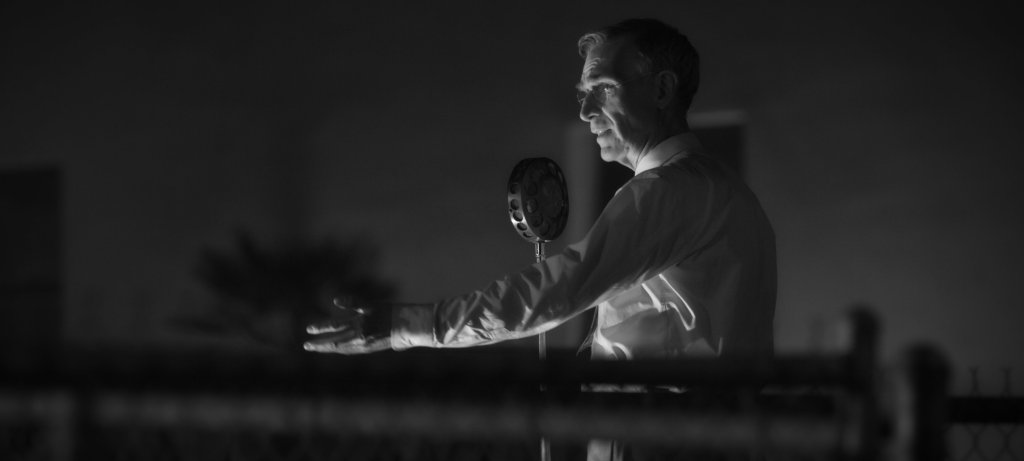
Bill Nye in Mank

Valid guy, but no. Although, if he had come out at the end to explain what happened and how it happened, that would have been appreciated. We needed clarity, Bill! Cold, hard facts! Where the hell were you??

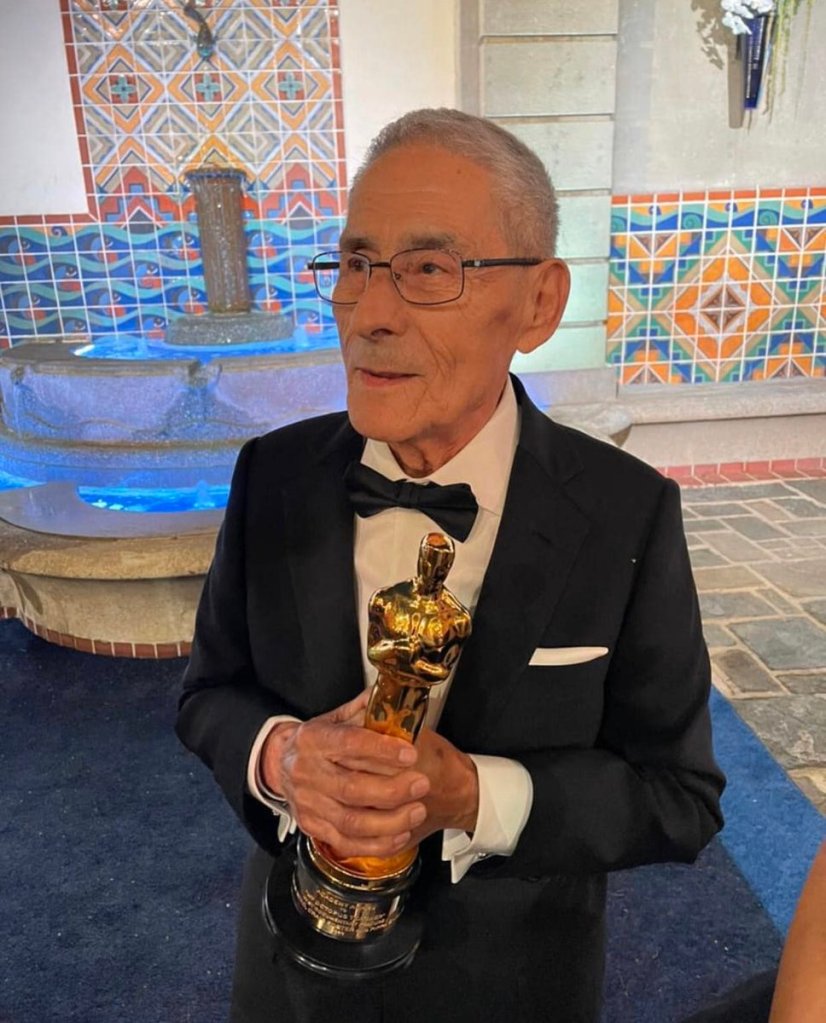
Sergio Chamy, the Greatest Spy to Ever Spy

This guy!

Who is This Guy?

If you recognize him, we’re best friends now.

Sergio Chamy stars in The Mole Agent, a documentary from Chile that follows the 83 year old as he infiltrates a nursing home.

How Does an 83 Year Old Infiltrate a Nursing Home?

See? This film already has you asking questions.

A woman is concerned her mother, a resident at the facility, is being abused and neglected. She hires a private detective, Romulo Aitken, who then puts out this help wanted ad:

ELDERLY MALE NEEDED. Retired, between 80 and 90 years old. Independent, discrete, and competent with technology.

Sergio gets the job and eagerly jumps into his new career as a spy.

His objective is clear; befriend the resident in question, document and record any misconduct or abuse, and check in daily with Detective Aitken.

Spy-in-Training Montage

Sergio lifts weights! Sergio dices an onion while blindfolded! Sergio runs up a flight of stairs!

Just kidding. Sergio learns how to use a smartphone.

To Infiltrate and Beyond!

It would be trite to describe Sergio as charming. He’s effortlessly so, but more importantly he’s genuine. The recent passing of his wife plays a pivotal role in both Sergio’s motivations and the trajectory of the documentary. He wants to help. He wants to connect. He wants to be distracted.

He wants to do something.

Sergio’s arrival at the facility has an immediate impact on all the residents, except one. Sonia refuses to speak to him. This would be fine with Sergio, who happily respects boundaries (as much as a spy can) except, well, talking to Sonia is his job. She’s the target and she’s having none of it.

As Sergio’s three-month assignment continues, we meet a carousel of magnificent characters. We come to know them even as they have forgotten themselves. Whether their memories are sharp or elusive, their essence still remains, and Sergio consistently finds it. It’s that intangible part of the self he never fails to see and it’s why residents seem to open their eyes wider, lift their heads higher, and find peace in their vulnerability when he’s around them.

Some of the most beautiful scenes are poignant and breathtaking (one resident’s consistent cries echo Anthony Hopkins at the end of The Father), but there’s a twist amongst all these feelings. This documentary is also very, very funny. There’s an 84 year old virgin who sets her sights on Sergio, a thief to be caught, and a frustrated boss who just wants Sergio to FaceTime him, for the love of God. All in all, Sergio’s adventure captures all the nuances of life kept behind the walls of a home for the elderly, who live in a cone of time that narrows and narrows until it reaches the final, conclusive point.

Eventually, Sergio’s time at the nursing home comes to an end as he finishes his investigation with troubling and heartbreaking discoveries. What we’re left with is a film that challenges our ideas of aging, our feelings towards the elderly, and questions not only how we spend our time on this Earth, but how we share it.

Sergio Was at the Oscars and I Didn’t Know?!

It’s true. The Mole Agent was nominated for Best Documentary. Director Maite Alberdi was in attendance and Sergio was her date. Traveling to Los Angeles marked the first time in his life he’d ever been on a plane.

I don’t know how he got his hands on an Oscar. He’s the Spy, not me.

The Octopus Teacher reigned victorious in that category and while it’s not a bad film, it certainly didn’t have the lasting impact of the other nominees. It feels akin to The Bee Movie besting films like Coco, Fantastic Mr. Fox, Spider-Man: Into the Spider-verse, and The Iron Giant.

An Oscar loss can never diminish a light that breaks through, though a win can help others see it when they otherwise might shield their eyes. If you’re in need of a post-Oscars palette cleanser, wander over to Hulu and spend 90 minutes with Sergio Chamy.

It’s worth your time.

The ToB and Me: A Love Story in Ongoing Acts

My general skill set is limited to mostly useless things. For example, when I was dating, my OkCupid profile stated very clearly you could always count on me knowing the name of that one actor in that one thing.

My husband agrees this still remains true.

I’m also very good at making pointless, impossible goals.

I’m going to watch every single movie nominated for an Oscar! (Never happens).

I’m going to listen to every podcast Vulture recommends! (Absolutely not).

I’m going to exercise! (Stop it).

I’m going to get my kids to bed on time! (Bullshit).

Enter, the Tournament of Books.

The Cliffs of Insanity

I’m going to read every book that has “competed” in the ToB.

Every. Flipping. Year. This is the goal I make. Per my astounding lack of completion, I’ve never achieved it.

“Oh, come on. You can’t get through 18 books? What the hell are you doing, doom-scrolling on Twitter all day while drinking your eighth cup of coffee and forgetting dinner’s in the oven?”

Wow. That cut me deep.

Here’s the thing, though. It’s not just the 18 books featured every year. I want to read all of them, going back to the first ToB in 2005 and including 2 ToB Camps, 2 Summer Reading Challenges, and 1 Non-fiction Pop Up.

Now, let’s do the math.

No, let’s not do the math. We can agree, it’s a lot of books.

Also, it will happen again next year, which means 18 new books added to the list. Every time I make a dent, the list grows longer. It’s a Hydra.

I can’t let go of it. I’m going to do this. I can do this. Hypothetically before death takes me.

But Why?

It’s important to have dreams.

I’ve loved ToB for many reasons, but primarily I love how it’s managed to diversify and enhance the reading experience.

Directly comparing books to each other and then choosing one to advance is nuts. Books are subjective. Every reader has their own, personal experience with a story that cannot be entirely replicated in another person. What good, then, can come from putting a collection of books into March Madness brackets and whittling it down to one winner?

It’s folly but it works. The ToB succeeds in three distinct ways:

1.) It exposes readers to a unique, well-curated variety of voices and genres. There are books I have profoundly loved that probably wouldn’t have been on my radar otherwise (A Tale for the Time-Being jumps to mind). The ToB covers bestsellers and indie gems, while celebrating diverse authors with extraordinary voices. Each book chosen is its own, stand-alone victory. Even if I reach the end and conclude the story wasn’t for me, I can’t deny the craft involved, the talent on display, the heart that went into it. There’s genuine intent here and it’s expanded my reading experiences significantly.

2.) The judges’ choices and rationales, along with the commentary that follows, has challenged me to be a more thoughtful reader. The ‘winner’ of each ToB bracket is often decided based on the smallest of nuances. The variety of books involved makes this all the more fascinating. Do you know how every movie nominated for an Oscar starts to feel like the same damn film? That never happens with ToB (or at least, hasn’t yet. I do still have 25,000 books to read). Differentiating the strength of each book requires a balanced look that is both technical and personal. I’m a better reader for the work they’ve shared and I am grateful.

3.) It’s fun! There’s suspense, controversy, upsets, underdogs, fallen giants, and a goddamn rooster. What more do you need?

Current Status

I’m working my way through the most recent ToB, which you can read in its entirety here. Thus far, it has failed to disappoint. There have been standouts and letdowns and I’ve loved every minute of it.

Except that one minute which was pretty freaking terrible. Burying that memory deep into the recesses of my brain now.

What I’ve Read So Far (2021 ToB)

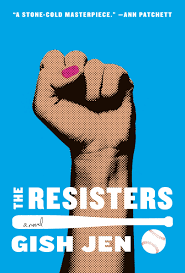
The Resisters by Gish Jen – Confirming all my worst fears about Alexa and her eventual rise to power, Jen’s dystopian novel is disturbingly plausible. However, the trajectory of the story was uneven and the most interesting character felt sidelined too often. But if you’re a fan of baseball and messenger pigeons, you can’t pass this book up.

Red Pill by Hari Kunzru – I didn’t know what to expect from this book and somehow it still wasn’t what I expected. It’s a slow descent into pain and fear, reminding you that too often, when you think you’ve come out on the other side, reality is always ready to strike. Kunzru pieces words together with breathtaking style. There were so many moments I had to stop and sit within his sentences in awe.

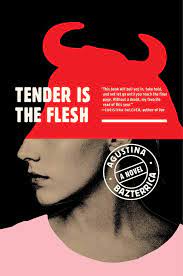
Tender is the Flesh by Augustina Bazterrica – This book fucked me up. I also happened to be reading it when the Armie Hammer news broke and I lost my goddamn mind. Couldn’t eat or even look at meat for months.

A Children’s Bible by Lydia Millet – More on that here.

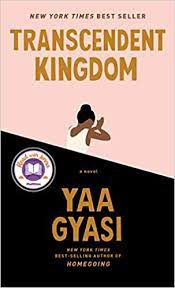
Transcendent Kingdom by Yaa Gyasi – A beauty, from beginning to end. Gyasi’s exploration of the relationship between science and spirituality is both relatable and eye-opening. With God planted in her roots, Gifty, a neuroscientist graduate student, grows up, out, and into the world, reaching for answers. Gyasi dances back and forth through time while managing to build a clear character arch from devout faith to doubt and rejection, landing ultimately at peace, though not resolution. It’s a wonder.

We Ride Upon Sticks by Quan Barry – Hey ’80s fans! Do you love field hockey? Are you super into the Salem Witch Trials? Does Emilio Estevez do it for you? Well, then Happy Birthday! Here’s a gift.

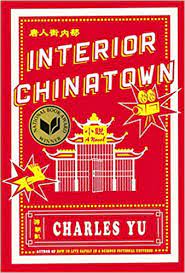
Interior Chinatown by Charles Yu – There is nothing I can say worthy of this novel. I was entertained, I learned a ton of fucked up shit I’d never known before, I gasped, I laughed, I cried, I marveled. Just…by freaking god, read this book.

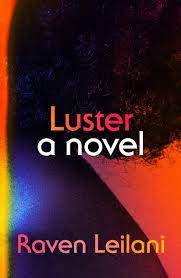
Luster by Raven Leilani – Luster is so casual in its intensity, it’s hard not to classify this book as a thriller. Edie, a young women curious, determined, lost, is a modern day Alice in the Wonderland of early adulthood in NYC. She’s full of want but too often caters to the desires of others (often to her detriment) as characters send her reeling in different directions. Throw in themes on race, capitalism, equality, and sexuality and you’ve got a cocktail that burns on the way down and lingers with warmth.

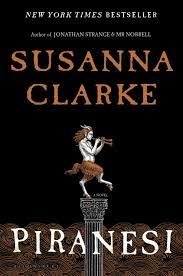
Piranesi by Susanna Clarke – I read this delight while acting in a production of The Tempest. As Piranesi navigates an isolated land with powerful oceans and struggles with an identity crisis, I couldn’t help but tie the stories together, wondering if Piranesi’s story could be the prequel to Caliban’s. This tale is magical. Though your time with Piranesi is brief, his spirit and faith stays with you long after the end. Highly recommend.

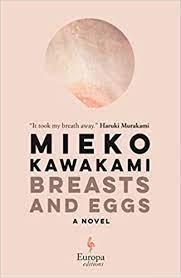
Breasts and Eggs by Mieko Kawakami – I really wanted to love this book. There is so much to praise about Kawakami’s insights and style. Narrated in two parts by Natsu, the first story focuses on her older sister Makiko and niece, Midoriko. Makiko is desperate for breast implants while her daughter categorically rejects the inner workings of her body. The second story belongs to Natsu and her desire to have a baby via sperm donor. Through it all are beautiful passages about every angle of femininity, biological or no. But it becomes preachy and repetitive quickly, the messages hammered into your brain. Despite some wonderful moments, I was relieved when I finally reached the end.

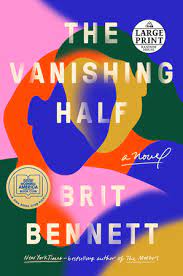
The Vanishing Half by Brit Bennett – A haunting, stunning, can’t-put-down work. I was enraptured from the start, following the differing paths of twin sisters Desiree and Stella. Mixed race with light skin, Stella leaves her family and hometown to live as a white woman while Desiree ultimately remains home with their mother. Race isn’t the only vanishing half at play here. A transgendered man transitions, an elderly woman lives with Alzheimers. The past drips away and yet these incredible, living, breathing characters both yearn for and fear it. Inevitably this will be made into a movie. Ron Howard better not come near it.

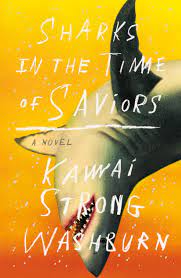
Sharks in the Time of Saviors by Kawai Strong Washburn – This was a completely transportive experience. Washburn’s story of family, traditions, tragedy, and healing is intertwined amongst the supernatural. I often thought of Haruki Murakami as Washburn made extraordinary events feel tangible. Marlon James also came to mind as Washburn gives his characters a genuine voice. In the end, Washburn is truly one-of-a-kind, showing us that miracles are what we make of them.

That Was Long

Yeah, sorry about that. But now I sally forth towards my goal! Which means eventually, you guys will be getting a totally relevant post on Cloud Atlas.

I know. I know. You’re welcome.

Booky Here: A Children’s Bible

Every year I plan on reading every contender for The Morning News’ Tournament of Books. The ToB is one of my most favorite things of all the things, so by golly, I’m going to read the entire list. I’m going to be an active, knowledgable participant. I’m going to leave minimum one comment, bonus points if it manages to be impressive. I’m going to be invested in roosters.

Shocking twist alert!

It never happens.

Second shocking twist alert!

Until now. (dramatic pause) Almost.

True, the 2021 ToB ended nearly a month ago. True, I still have five books to read in order to complete this part of my goal (more on that in a different post). True, the ToB Summer Camp shortlist was just released, adding to my increasingly disturbing ‘to read’ pile.

No matter! I sally forth!

What Does This Have to do with A Children’s Bible?

Ummm. A Children’s Bible was a ToB contender this year.

That’s It?

Yes.

By God.

Nope, this one is by Lydia Millet.

Wow, That Was a Hell of a Segue

And here we are on the other side.

If I could ‘Eternal Sunshine’ my brain in order to read A Children’s Bible without knowing a single thing about it before hand, I would.

A Children’s Bible is absolutely worth the read. I do recommend it. However, I believe prior knowledge of the plot and structure impacted my experience with the novel and not for the better.

Go in blind. Don’t even read the inside flap! Trust me on this one. And then please come back and tell me what it was like.

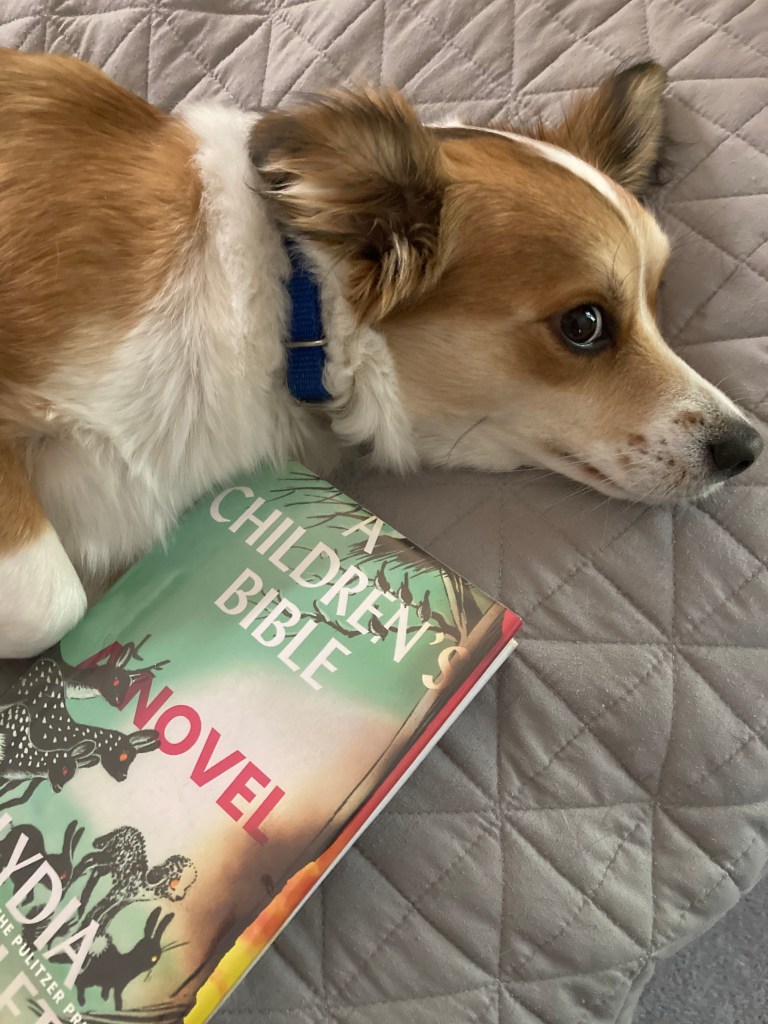
If that’s what you’re going to do then get outta here. Significant information and spoilers are ahead. Here is a picture of my dog Jeff, pondering the themes and meaning of the book, in order to help you avoid even a glance at ruinous words.

Jeff the Dog ponders A Children’s Bible

Hello, humans who have read the book or don’t mind knowing what’s going to happen before it happens. Let’s do this, shall we?

In the Beginning

The End of the World has been on everyone’s minds, ironically since the beginning of time. Each moment since has contributed to the Grand Finale and now, thanks to man-made foreshadowing, we’re getting a good idea of how this is all going down. Naturally, our storytellers have something to say about this.

The Bible, much like a Terrance Malick film, attempts to cover the entirety of existence while highlighting some choice characters and moments, including a talking donkey who doesn’t get the credit he deserves. The average Bible is about 1,200 pages long. Lydia Millet breezes in at a cool 224. Am I saying she’s a better writer than God? Well…she’s certainly more succinct.

When I was young and growing up in a religious household, I had many different kinds of picture Bibles. My favorite one was laid out like a graphic novel. I would read it over and over and over again, enraptured, terrified, desperate. I needed it to understand the world around me and feel secure. I believed each story with my entire heart and I knew, if I could just open my eyes a bit wider, search a bit deeper, I could hear God.

That child would be appalled by the woman she became. Yet, while reading A Children’s Bible, I couldn’t help but remember her with a bit more empathy than I usually do. What are children supposed to do when the world around them doesn’t make sense? Where can they go for answers when there are none?

“Those who trust in their riches will fall, but the righteous will thrive like a green leaf.

Whoever brings ruin on their family will inherit only wind, and the fool will be servant to the wise.

The fruit of the righteous is a tree of life, and the one who is wise saves lives.”

Proverbs 11:28-30 (NIV)

Chapter and Verse

12 youth have gathered at a lakeside mansion with their parents for a summer vacation. Our narrator is Eve, a teenage girl fiercely devoted to her younger brother Jack. A distinct line has been drawn between the kids and their parents, two different worlds living side by side, rarely seeping into each other.

The kids are disgusted with their parents who seem to only be committed to destructive vices and indifferent to their offspring. The parents are just that, never named, all of them Guess Who? characters to be flipped face down and forgotten. Understandable, given the situation. Climate change is having the last laugh and, yes, it’s the End of the World.

Where do the kids place the blame? Squarely on their affluent, clueless, detached, selfish parents. At war are two generations, both of which will never and have never achieved adulthood, a battle between “what can we do?” and “there’s nothing to be done”.

When a catastrophic storm hits, the kids escape, led out of bondage by Burl, a man they discover, by chance, sleeping amongst the reeds.

Oh, and during the storm, the kids took refuge in a wooden treehouse where Jack had gathered as many animals as he could.

Oh! And there are twins who get in a fight and one hits the other on the head with a rock.

Any bells ringing? Trumpets blowing?

Yes, as the story continues, the Bible comes to life in myriad scenarios. This was, in turns, both wonderfully fun and clever, oftentimes sobering and sickening, and so, so distracting.

A Testament

I knew from the start various parts of the Bible would be interwoven throughout the plot. As a result, I sought them out, trying to tie each event and character to a story or parable. I segmented the book mentally as I read.

It wasn’t until the end that I was able to step back and appreciate the book as a whole. It is its own, complete story, with characters alive in our own future But because I was so focused on the Bible story quest, I missed out on natural discoveries, those glorious ‘ah ha’ moments a well crafted book provides.

Millet is best when she trusts the reader to recognize the connections. Occasionally she doubts. Jack, who becomes fascinated with a picture Bible, will often say “Hey! This is just like what happened in my book!” That kind of telling hurts my soul a little bit.

Another example is Mattie, a man who teaches biology, explaining life, how it works, how to care for it, in a way that keeps every child at his feet listening. Eve describes the scenario:

“Biology was the best. It was held in the barn, where Mattie pulled up diagrams on his laptop and projected them onto a whitewashed wall…

Others joined the class, more each day…I’d watch from the open door and see them looking studious, their faces faithfully turned forward. They could have been children in school in a bygone era…

Children who sat there learning from their teachers, full of trust. Secure in the knowledge that an orderly future stretched ahead of them.

They sat quiet, gazing up at the projections…

After a while we were so devoted to those pictures that we were almost disciples.”

A Children’s Bible by Lydia Millet, pages 135-137

The descriptions of the wonder and devotion? Beautiful. Telling us they were like disciples? Just smash me in the face with the King James, please.

There are, however, plenty of moments that are, no pun intended, simply divine, particularly the receiving of the Ten Commandments which was hysterically perfect.

Regardless, Millet creates so much with so little. We recognize these children as both our own and ourselves. We shake our fists at their foes but also know we’ve been complicit. We want to save them, help them at the very least. Millet is telling us we can, but we must do it here and we must do it now.

Revelation

A Children’s Bible is full of chaos and blood. Death, violence, murder, disease, it’s all there.

There’s also love, wisdom, connection, sacrifice, patience, and hope.

The Bible has been used to justify a lot of shit throughout history. It’s a voluminous to-do list, full of contradictions and punishment. Then Jesus comes along to help us make sense of it all and he tells us this:

“Love the Lord your God with all your heart and with all your soul and with all your mind. This is the first and greatest commandment. And the second is like it: Love your neighbor as yourself. All the Law and the Prophets hang on these two commandments.”

Matthew 22:37-40 (NIV)

One of the most beautiful and memorable moments in A Children’s Bible comes when Jack declares he’s solved the “mystery” of the Bible and explains who God and Jesus really represent. I won’t give it away, if you’ve decided to read all this before reading the book. It deserves to be a genuine experience. But the message of both Bibles is clear.

We must take care of each other.

Everything depends on this.

Otherwise we will be left with nothing but wind, and here on Earth the wind will break us.


A Children’s Bible by Lydia Millet is available at Quail Ridge Books, Bookshop, at your local library, and literally anywhere that isn’t owned by Jeff Bezos.

The Only Spot for Me is Mine

Well, it took being fired a record three times in less than a year to come back to this space.

I’m happier to be here. I feel released into the wild, allowed to roam, make noise, climb, leap, saunter, nap.

And yet I keep looking back at the cage and thinking “but that’s where I’m supposed to be.”

Every time I’ve tried to break this cycle, I swing right back into it within a week or two. The disgusting chomp chomp of Doubt Monsters eating me from the inside overtakes all my senses and soon enough I’m saying ‘yes’ to work I have no business accepting nor any desire to do and I hate myself.

Complicating the matter further is genuine gratitude. I’m profoundly lucky and privileged. My family is provided for. I work as a writer. That’s what I am. A writer.

Though…not the writer I’d like to be or maybe not the writer I’m ready to say I am.

Yeah, that’s it. If Michael Scott can declare bankruptcy, I can declare my profession.

A Declaration in One Scene

(A nondescript female stands in the middle of a cul-de-sac. It’s unclear where she came from. She might live near by…or not…but she seems pleased with this spot she’s chosen. She takes a deep breath and begins to shout)

Nondescript Female: I am a writer! A writer who reads! A writer who writes about what she reads!

(She begins to leave but then remembers that’s not all and runs back to the center of the cul-de-sac, reclaiming her spot)

Nondescript Female: That’s not all! I write about other things, too! Most likely!

(She pauses to consider adding a disclaimer)

(Yes, she should add a disclaimer)

Nondescript Female: NOT SOFTWARE. Mostly movies and shit. Like experiences. And politics, maybe. Or parenting. Or, like, podcasts? I don’t know! I’m figuring it out!

(She sees a child on a bike, staring at her. The child is confused. Is this woman stranger danger or should he feel sorry for her? His parents told him it’s not polite to stare but it seems like they would understand his choice to if they were here)

Nondescript Female: Sorry I said shit.

(She exits. The child remains unsettled for another 15 seconds, then goes home and eats a granola bar, leaving crumbs everywhere. Asshole.)

The Part Where I Commit to the Void

Yeah, I’m doing this. I mean it this time. For real. Really real. It’s happening. Can’t be stopped. I lit a fancy candle damnit, so clearly I mean business.

I’ve wasted so much time whining about not being able to write what I want to. The only thing standing in my way was me.

I thought I needed permission or an invitation. I thought I had to wait until a spot opened up and then stand patiently in line until it was decided I was ultimately not wanted.

Why have I been afraid of my own words?

I’ve spent years trying to find my place, my spot. By freaking golly, it was my own backyard the whole time. Boy, that message flew over my head. Sorry, Dorothy.

Alright! Putting words out there! Yes! Resisting strong urge to issue an apology!

Unless you ask for one, in which case I will very likely apologize and probably send you a pizza or some other token of desperation.

One of Us, One of Us

What are your “should’s”? What are your “like to’s”? Why have you stayed at “I will”? Why aren’t you ready for “I am”?

Believe me, I know that’s a hornet nest we all avoid disturbing. I don’t know about you, but my excuses usually were along the lines of:

“I’m not qualified”

“I don’t have the right tools”

“I will do a bad job”

“The hornets will hurt people I care about”

“I don’t have time”

“This is how the murder hornets get you and behold, I will devastate them with my indifference”

It took me far too long to admit that was all bullshit and the real answer was simple. I was afraid.

That’s…still true.

Join me?

What’s the Point?

We’ve almost reached the end of 2020.

That gap between now and then looks cavernous.

By god, how did we get here?

By ‘here’, I mean how did we get to another white mom starting her own blog in an effort to craft a writing career during the end times.

I only have selfish answers. I’m sorry.

I’ll do my best to make it up to you.


Current stats

Unemployed: Yes

Married: Yes(!)

Quarantined: Yes

COVID-19: Negative

Kids in Virtual School: 6

Dogs: 3

You want to see the dogs, don’t you. If you insist.

Kelley Deal Photography

“Wait. You said there were 3.”

I did say that. Excellent reading comprehension. We also have my mother’s dog staying with us for the time being. His name is Buster.

Husband iPhone Photography

This is our starting point; figuring out what to do, nowhere to go, plenty of kids and dogs. One of them is Buster.


There are so many things I should do. It’s impossible to shake that pressure and quarantine has only made it worse. If you’re not doing anything, accomplishing anything, contributing anything, then…well…what’s the point?

It’s one of those vulnerable “meaning of life/personal purpose” spots that gets you trapped in NXIVM.

Let’s avoid that, shall we?

Days somehow both rush and drag by. There’s no shortage of activity. But at the end of the day, it’s hard to feel like anything’s been done. I’ve attributed this to the pandemic and the time rift it’s caused. But I’m not sure that’s the case.

Maybe it’s always been this way and the pandemic allowed us to see it up close. That’s certainly been the case for so much of what America runs on. It’s not Dunkin. It’s greed and despair. Everyone’s been ok with it. Somehow plenty of people are still ok with it.

How did we get here?

And by ‘here’ I mean on the precipice of America’s final undoing wrought from the inside by fascists trumpeting God and Country. The usual.

Where do I fit in all this? Where do you? Where do we want to fit?

What’s the point?

I don’t know, but I’m going to write anyway.